









by Brent W. Hubby, on Dec 14, 2022, 9:41:00 AM

Updated Sep 16, 2026
PDP ProScan and Predictive Index (PI) are both workforce behavioral assessments used for hiring and talent management. However, PDP ProScan offers deeper psychometric accuracy, burnout tracking, and non-discriminatory hiring metrics without forcing candidates into rigid profile categories.
Key Takeaways
- Granular Measurement: PDP ProScan utilizes a 5-point Likert scale to capture nuanced behavioral traits, whereas Predictive Index (PI) uses binary checklist descriptor boxes that limit response granularity.
- No Rigid Typing: PI forces candidate results into one of 17 static reference profiles. PDP ProScan delivers dynamic summary paragraphs and individual trait measurements tailored to each candidate.
- Stress & Burnout Metrics: PDP ProScan tracks workplace energy drain, stress levels, and job satisfaction drivers. PI does not measure energy drain or burnout risks.
- Gold-Standard Validation: PDP ProScan is validated by 3 Confirmatory Factor Analyses (CFAs), 11 Exploratory Factor Analyses (EFAs), and 3 Item Response Theory (IRT) analyses across 195,000+ working adults, while PI relies primarily on unpublished internal studies.
What Are the Origins of Predictive Index and PDP ProScan?
The Predictive Index (PI) was created in 1955 by Arnold Daniels, who was introduced to psychometrics while serving as a flight navigator in the U.S. Army Air Corps. Daniels recognized that measuring work-related personality traits could help businesses evaluate candidate behavioral drives.
PDP Global was founded by Bruce M. Hubby, a former Predictive Index analyst. Hubby sought greater statistical integrity than PI offered, leading him to build ProScan from scratch using 185 personality adjectives based on research by Thurstone, Cattell, Guilford, and Fiske. First developed in 1976, ProScan has maintained a 98% user-accuracy agreement rating in field testing since 1977.
How Do Assessment Outputs Compare Between PI and PDP ProScan?
PI measures four personality traits (Dominance, Extroversion, Patience, Formality) using a checklist format. Test-takers evaluate adjectives twice: how they are and how others expect them to be. Because respondents can skip words or compare options directly, results can be easier to manipulate or skew. PI then assigns individuals to 1 of 17 fixed reference profiles, which restricts candidate evaluation to a limited set of categories.
PDP JobScan is similar to the PI job assessment in that it measures the key traits that are desirable for a particular position. The PDP ProScan Survey can then assess individuals for their behavioral traits and match them against the profile desired for a particular job.
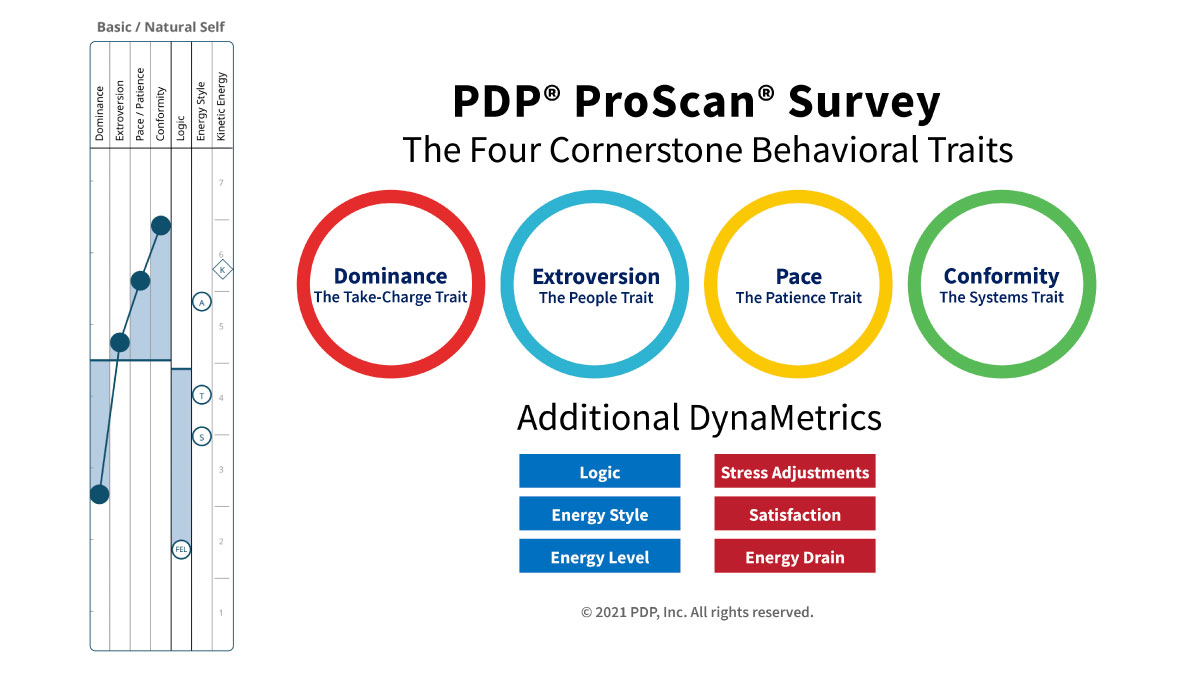
However, there are some important differences between PDP and PI behavioral assessments. PDP’s ProScan uses a five-point Likert scale to measure how strongly someone agrees or disagrees, which provides better granularity than the PI assessment method of simply checking black-or-white word descriptor boxes.
ProScan then provides summary paragraphs that describe each individual’s traits, rather than assign them a personality type. Summary paragraphs allow for much more diversity and flexibility and don’t confine candidates to pre-defined personality types.
ProScan also measures employee satisfaction and energy drain while PI does not. ProScan reports take the two sets of behavioral data (from an individual's natural state and also how they feel they should be) and determine the stress an employee feels as they try to adjust between the two.
For example, if someone is more introverted but must talk to many others all day for their role, they could be over-extending their natural trait. ProScan predicts whether the adaption of someone's natural trait tendencies compared to how they feel they need to be will result in positive or negative job satisfaction overall.
Moreover, ProScan considers energy drain to reveal whether an employee is on the verge of burnout. The amount of energy an employee starts with at the beginning of the day versus the energy that's left after the day's demands is the energy drain metric. Someone may feel continually exhausted if the energy drain is too great since employee well-being, productivity, and performance stem from energy.
PDP also offers TeamScan, which helps business leaders understand the success drivers of their core teams and the organization as a whole. This unique instrument helps increase team harmony and build a productive organizational culture.
What Is the Research and Validation Behind PI vs. PDP ProScan?
PI reports over 400 internal job performance studies across 25,000 participants. However, these studies are not open for public viewing, and it is unclear if PI has undergone Confirmatory Factor Analysis (CFA).
PDP ProScan demonstrates industry-leading statistical reliability and scientific rigor:
- High Reliability: Achieved an initial Cronbach’s alpha score of =0.94 (far exceeding the standard 0.70 benchmark).
- Gold-Standard Studies: Completed 11 Exploratory Factor Analyses (EFAs) and 3 Confirmatory Factor Analyses (CFAs)—the psychometric gold standard—involving over 39,000 working adults.
- Response Integrity: A data quality control and integrity methodological study was conducted in late 2024. These analyses provide an additional layer of quality control by supporting the identification of responses requiring further inspection and helping ensure that ProScan remains a trusted and reliable source for trait assessment.
- Legal Integrity: Independently verified by the Center for Applied Psychology at the University of Colorado at Denver to produce zero disparate impact under EEOC and ADA standards.
When Should Businesses Choose PDP ProScan Over Predictive Index?
While PI is primarily used as a top-down tool by managers, PDP ProScan serves as a complete workforce management system for both leaders and employees:
- For Candidates and Employees: Provides detailed individual reports that foster personal development and growth rather than short profile summaries.
- For Team Leaders: Utilizes TeamScan to align group dynamics and reduce interpersonal conflict.
- For Organizational ROI: Helps companies decrease turnover, optimize candidate interviews, measure employee stress, and spot quiet quitting early.
Hire, Motivate, and Retain with PDP Behavioral Assessments
PDP assessments help you build effective team cultures. They give you the power to select the people who are the best fit for a job, build team morale, and become more productive.
Curious how PDP can help take your team to the next level? Try a complimentary PDP assessment.

Frequently Asked Questions
What is the main difference between Predictive Index (PI) and PDP ProScan?
Predictive Index assigns candidates to 1 of 17 fixed reference profiles using a binary checklist, whereas PDP ProScan uses a 5-point Likert scale to measure fluid behavioral traits, workplace stress, and burnout risks without forcing fixed categories.
Does Predictive Index measure employee stress and burnout?
No, Predictive Index does not track energy drain or workplace stress levels. PDP ProScan specifically measures energy drain to alert leaders when employees are near burnout.
Why is PDP ProScan harder to manipulate or cheat than PI?
Predictive Index uses simple checklist descriptor boxes that allow direct comparison between items. PDP ProScan uses a 5-point Likert rating scale across 148,000 background computations, preventing respondents from easily skewing results.


