









by Brent W. Hubby, on Nov 15, 2022, 1:12:00 PM

Updated Sep 16, 2026
PDP ProScan provides statistically validated, non-discriminatory behavioral data engineered to optimize corporate hiring, team alignment, and employee retention. While the Enneagram is popular for individual growth, its lack of psychometric validity makes it unsuitable for workplace selection decisions.
Key Takeaways
- Core Difference: The Enneagram is a spiritual, type-based framework used for personal self-awareness, whereas PDP ProScan is an empirically validated behavioral assessment built specifically for business talent selection and management.
- Scientific Validity: Independent studies show mixed or poor reliability for Enneagram types (rated "discredited" for business selection by over 25% of surveyed psychologists). PDP ProScan is backed by 3 CFAs, 11 EFAs, 3 IRTs, and recent data from over 195,000 working adults.
- Hiring & Legal Compliance: The Enneagram is not validated or compliant for pre-employment hiring. PDP ProScan is EEOC- and ADA-compliant, with zero disparate impact based on age, gender, or race.
Overview Comparison: PDP ProScan vs. Enneagram
The following table summarizes the key differences between the Enneagram personality test and PDP Global’s ProScan behavioral assessment for business use.
| Category | Enneagram Personality Test | PDP ProScan Behavioral Assessment |
|---|---|---|
| Primary Purpose | Self-awareness and personal development | Hiring, performance, and talent strategy |
| Output Style | 9 personality types with wings | Behavioral traits, motivators, adaptability |
| Research Support | Mixed evidence for reliability and validity | Extensive validation (EFAs + CFAs, 39,000+ respondents) |
| Workplace Use | Not designed for selection decisions | Built for job fit, retention, and team effectiveness |
| Compliance | Not intended for employment decisions | EEOC and ADA compliant |
What Are the Origins of the Enneagram vs. PDP ProScan?
The modern Enneagram originated with Bolivian philosopher Oscar Ichazo, drawing on spiritual and philosophical traditions, including Judaism, Christianity, Islam, Taoism, Buddhism, and Ancient Greek philosophy. Popular test variations include the Riso–Hudson Enneagram Type Indicator (RHETI) and the Essential Enneagram.
PDP Global developed ProScan empirically to solve a corporate need: selecting and retaining top talent. Built on quantitative behavioral research by Thurstone, Cattell, Guilford, and Fiske, ProScan evaluates observable workplace behavior rather than abstract spiritual concepts.
How Do Enneagram Types Compare to PDP ProScan Metrics?
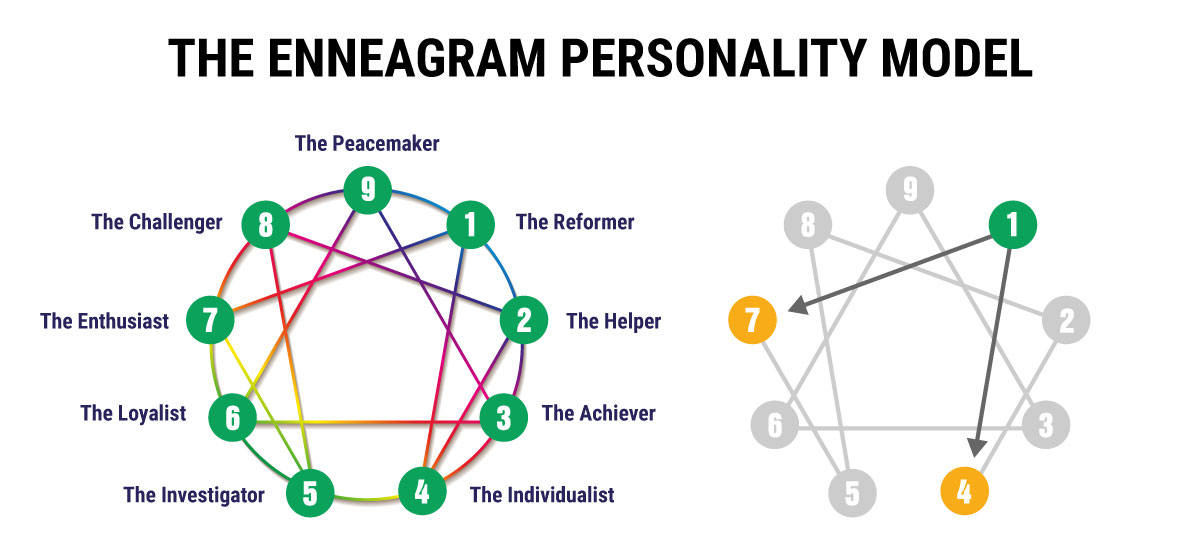
Enneagram Output
The Enneagram assigns individuals to one of nine static personality types (e.g., Type One) along with secondary "wings". It describes generalized behaviors under stress or relaxation but does not measure specific job-fit competencies.
PDP ProScan Output
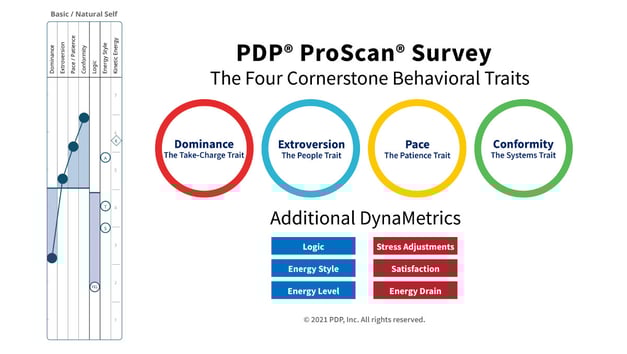
PDP ProScan measures four cornerstone traits (Dominance, Extroversion, Pace/Patience, Conformity), Logic, and Workplace Motivators. It evaluates these traits across three distinct dimensions:
- Natural Self
- Priority Environment
- Outward Self
To extend utility across the employee lifecycle, PDP pairs ProScan with JobScan (to benchmark ideal candidate traits) and TeamScan (to analyze organizational culture and team dynamics).

What Does the Scientific Research Say About Each Assessment?
Enneagram Scientific Support
For any behavioral assessment to be useful, especially in professional settings, it must demonstrate reliability (consistent results) and validity (measuring what it claims to measure). Overall, research on Enneagram-based assessments shows mixed or limited evidence of reliability and validity.
Key findings from published studies include:
- A study of 1,039 participants using the Open Enneagram of Personality Scales found poor internal consistency and weak test–retest reliability
- A study of 287 participants using the Riso–Hudson Enneagram Type Indicator (RHETI) found reliability was adequate for six types, but inadequate for three (Newgent et al., 2004)
- A systematic review of 104 independent samples reported mixed support for the Enneagram’s underlying nine-type structure, finding that factor analysis provided little evidence for nine distinct personality categories and that reliability and validity estimates varied across types (Hook et al., 2021)
These results are reflected in professional evaluations as well. In a Delphi poll of 101 doctoral-level psychologists, at least 25% rated the Enneagram personality theory as “discredited" (Norcross et al., 2006).
PDP ProScan Scientific Support
In contrast, PDP Global’s ProScan behavioral assessment is supported by decades of empirical research focused on workplace performance, selection, and organizational outcomes. The original validation studies, conducted in the 1970s with working adults (rather than undergraduate-only samples), found:
- Excellent reliability (Original research α = 0.94)
- Strong evidence of validity, with concurrent validity correlations ranging from 0.39 to 0.87
PDP has continued to evaluate and strengthen ProScan through ongoing research. From 2019 to 2021, PDP conducted multi-year studies, achieving three highly rigorous Confirmatory Factor Analyses (CFAs).
Key outcomes include:
- All three CFAs produced Cronbach’s alpha coefficients above 0.87
- Over 195,000 respondents contributed to recent ProScan research
- The assessment underwent:
- 11 Exploratory Factor Analyses (EFAs)
- 3 Confirmatory Factor Analyses (CFAs)
- 3 Item Response Theory analyses (IRT)
Previous research also demonstrates that PDP assessments:
- Correlates directly with job performance
- Show no disparate impact across demographic groups
- Are compliant with EEOC and ADA standards
PDP Global’s validation methods have been endorsed by the Center for Applied Psychology at the University of Colorado at Denver and align with American Psychological Association standards, as well as the Society for Industrial and Organizational Psychology’s principles for personnel selection procedures.
When Should Businesses Use PDP ProScan vs. the Enneagram?
The Enneagram is suited for voluntary personal reflection and team communication exercises. Because it lacks predictive validity, it should never be used for hiring, promotion, or talent management decisions.
PDP ProScan is designed for corporate workforce management. Organizations use ProScan to:
- Standardize pre-employment candidate screening and onboarding.
- Match candidates to roles based on objective behavioral fit.
- Identify early signs of employee stress, burnout, and quiet quitting.
- Lower turnover, reduce workplace conflict, and drive profitability.
“PDP Global has given us a level of insight into our people that we never had before. It’s not just about hiring the right person; it’s about setting them up for success in the right role. Seeing someone go from struggling in a position to thriving as a leader because of this instrument—that’s a game changer.”
— Margaret Johnson, Chief Human Resources Officer

PDP Global Improves Your People Strategy
Understanding the behavioral profile of your team and applicants helps organizations make better hiring decisions, strengthen collaboration, and improve long-term retention. While the Enneagram can support self-awareness and personal development, it was not designed as a validated tool for workplace selection or performance prediction.
PDP Global’s ProScan behavioral assessment is purpose-built for business use, providing objective, research-backed insights that help companies align people to roles, improve team effectiveness, and drive measurable results through smarter selection, motivation, and retention strategies.
Ready to see the impact for your organization? Try a free PDP assessment by requesting a demo today.

Frequently Asked Questions
Can the Enneagram be legally used for hiring candidates?
No, the Enneagram is not statistically validated for pre-employment screening and lacks proof of EEOC compliance, creating legal risks if used for hiring.
What is the main difference between PDP ProScan and the Enneagram?
The Enneagram categorizes individuals into nine fixed spiritual personality types for self-reflection, whereas PDP ProScan measures fluid workplace behaviors and motivators to predict job performance and role fit.
Is PDP ProScan compliant with EEOC and ADA hiring laws?
Yes, independent research by the University of Colorado at Denver confirmed that PDP ProScan produces zero disparate impact across race, gender, and age.


